Category Archives: gendertreyf

trans health care: a taxonomy of HRT access

in the department of screaming into the wind, it seems useful (if perhaps optimistic) to try to be concrete about the different pathways that trans liberals and antitrans organizers alike try to conflate, as part of their shared commitment to Professional Expertise (a/k/a doctors; a/k/a gatekeeping). that’s especially visible right now, as they attempt to redefine “DIY” in the context of HRT, pushing to keep us all dependent on state-licensed gatekeepers for access to the drugs many of us use, need, and want.

in the u.s. there are four basic pathways for getting drugs that you can use to adjust your endocrine system. (the specific examples i use are going to be about estrogens, since the greater legal restrictions on testosterones have made the process of developing autonomous pathways slower and quieter – but the same structure applies.)

two are commercial:

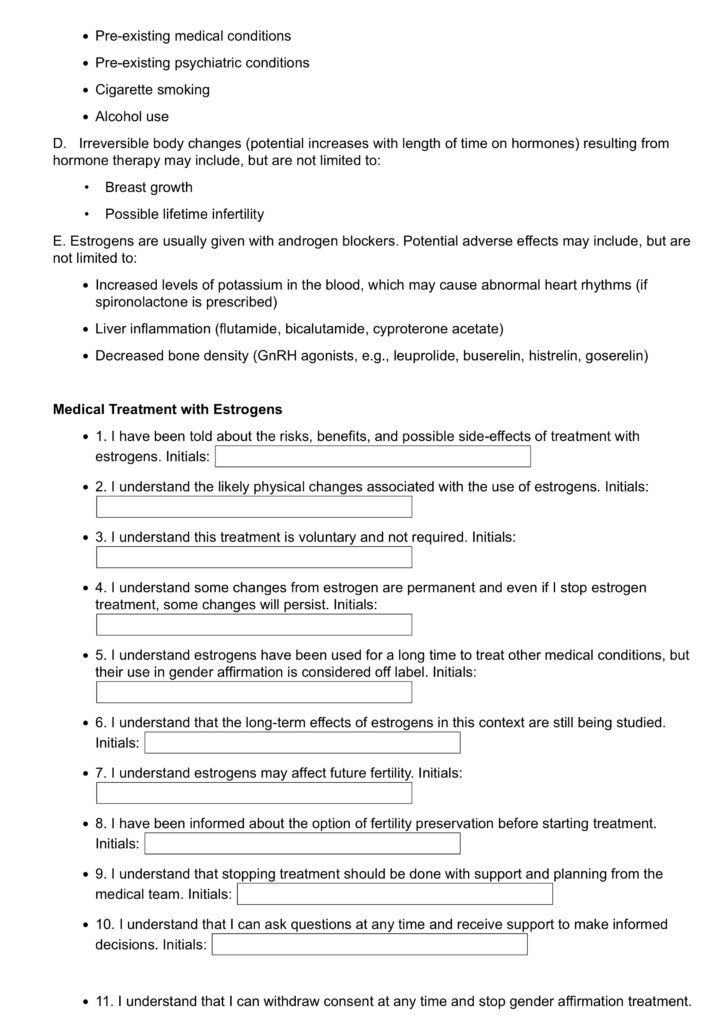
(1) by prescription. you go to a state-licensed gatekeeper, persuade them that you meet one or another set of arbitrary criteria, and are then allowed to pay a pharmaceutical company (directly or through an insurance company) for one drug off a very short list of possibilities1, with a state-licensed pharmacy taking a cut off the top.

(2) from unlicensed pharmacies/dealers. you go to a website2, and pay them (often using one or another form of blockchain pseudo-currency) to send you however many drugs you want, off a longer list of possibilities. the drugs come from the same manufacturers that supply the pharmaceutical companies.

two are autonomous:

(3) from community-based compounding projects. you go to a table at an event, or some other distribution point, and are given one or more drugs from a very limited selection3 (which is often just a choice between injectable and transdermal preparations of the same drug). you may be asked to contribute a nominal amount to support the ongoing project, but are not refused drugs if you can’t pay. the drugs are compounded (put into usable form) by community members, with the raw drug coming from the plants that supply the manufacturers of the commercial versions.

(4) from community-based redistribution projects. you go to a distribution point and are given a choice of whatever drugs they have on hand, which mainly come from the limited options available by prescription. you may be asked to contribute a nominal amount to support the ongoing project, but are not refused drugs if you can’t pay. the drugs come from either the prescription pathway (#1) or the community compounding pathway (#3).

there is a third possible autonomous pathway. i’m separating it off because i don’t know whether there are any projects currently working on using it. i hope there are, and i hope that they’re being very careful who they talk with about it.

(*5) from community-based production projects. when this exists, you’ll go to a distribution point (likely one established for the community compounding (#3) pathway) and choose from a limited selection on a pay-what-you-can basis. the raw drugs will come from a community compounding project, using raw drugs synthesized by a community-based manufacturing project.


of these pathways, only #3 is “DIY” in any meaningful sense (and #5 will be once it exists). #1 and #2 are gatekept efforts – one by the doctors and pharmacists who control access to prescription drugs; one more impersonally, by the prices they charge; #4, though very useful as a way around doctors and pharmacists, is basically dependent on #1 rather than an alternative to it.

but the distinction that matters here is between commercial and autonomous pathways of access. #3 and #4 (and #5 once it exists) are pathways in which trans people are directly supplying trans people with drugs, without the gatekeeping presence of either Professional Expertise or the profit motive. within the autonomous zone, #4 is much more limited in its scope than #3, since its supply of drugs depends on donors who both can persude a doctor to give them a prescription and don’t need to actually use all of the drugs they’re prescribed. these pathways are not in competition with each other, and can be mutually supportive: one of the useful functions of #3 can be to provide drugs to people with prescriptions, so that their pharmacy-packaged supply can be redistributed through #44.

importantly, #2 is neither “DIY” nor autonomous in any meaningful sense. it’s an alternative to getting drugs by prescription, but it is neither community-controlled nor based on providing the maximum access to as many people as possible. and given that the people most likely to be uninsured (and thus without access to prescription drugs made affordable by insurance coverage) are poor people, no commercial operation does much of anything to change the patterns of who can and can’t get access.

trans liberals and anti-trans organizers both participate in the demonization of what they call “DIY hormones”. they tend to focus on #2, using the legitimate reasons to be especially cautious about that pathway5 as a starting point for attempts to discredit any pathway that doesn’t run through state-controlled gatekeeping checkpoints – that is, anything but #1. their arguments are garbage, and i won’t even get into rebutting them here.

but it’s important that we not accept their redefinition of “DIY”. if it’s not community-based and community-controlled, with no barriers to access (economic, diagnostic, age-based, or otherwise), it’s not DIY. it may be good; it may be useful; it may not involve the state directly. but it’s not DIY if we aren’t doing it ourselves.

if the past decade has taught us nothing else, it should teach us that we cannot rely on the state to provide or protect trans people’s access to health care of any kind. what the state gives – grudgingly, belatedly, and stingily – can be taken away by that same state – rapidly and enthusiastically – always, and at any time. “legality” doesn’t come into it; the state, after all, is what decides whether a law will be ignored or enforced (that “discretion” is an inextricable element of the state as a structure, at the core of every state, whether a theocracy, a people’s democracy, or a parliamentary republic).

autonomous trans health infrastructure is the only way that we can actually maintain access to the drugs and the care we need. community-based compounding and redistribution projects are laying the foundations for the decentralized network that will save our lives – if we make those foundations strong and broad, and build on them!
  1. on the estrogen side, usually the only drugs that are available by prescription are estrodiol cypionate and estradiol valerate (which can come in injectable, tablet, or transdermal forms). these have a notably steep absorbtion curve, which means that the drug’s effects vary significantly over the time between doses (for injectable versions, often a week). ↩︎
  2. or potentially, for some forms of testosterone, a dealer catering to the gym-rat/body-building crowd. ↩︎
  3. most current community compounding projects are making estradiol enanthate, which has a flatter absorbtion curve than cypionate or valerate, meaning that its effects are less variable over the time between doses). ↩︎
  4. this shift of prescribed supply can be useful in many ways: there are situations where it’s safer to carry a vial that has a manufacturer’s label on it (including at borders); some people are scared of or hesitant to use DIY-compounded drugs; some people prefer valerate or cypionate over enanthate; etc. ↩︎
  5. which have much more to do with past periods of trans health access than the present. in the past, many (if not most) unlicensed sources were charging high prices for low-quality drugs, and often drugs that had been replaced in the prescription sphere. and some were selling actively harmful drugs, or alleged drugs that didn’t actually do anything. that’s much less true today. that’s much less true now, because the push to drive pharmaceutical manufacturing into low-wage overseas factories has made it much easier to get access to the supply chain for “legitimate” drugs, at either as raw materials (#3) or fully-produced medications (#2). but the profit motive can still lead to dangerous cost-cutting measures that make the actual dosage not match the label, or use harmful materials in the compounding process. and as in past periods, that a commercial supplier is trans, or has trans people willing to vouch for them, does not make them any less motivated by profit. ↩︎

for the record…

well, i went back to look at something i wrote in september 2018 about the then-upcoming midterm election. and while i may have overestimated the degree that the senior partner in the current bipartisan fascist regime had its shit together then, and thus gotten some details wrong, it holds up well enough as a description of this year’s midterm election for me to post it here unedited:

Continue reading for the record…

Repair and RETVRN

lies, shams, and “tikkun olam”

this is a slightly repetitive collage of various things i’ve written about “tikkun olam”/”tikn oylem”1 as a framing for jewish liberatory work, arranged according to the ACT-UP rubric for criticizing and rejecting supposedly helpful policies and programs: “it’s a lie, it’s a sham, and it won’t work”.

It’s A Lie

in the 1970s, a cluster of young liberal Zionist men entered jewish political and religious life (i’ll get to some of the key figures in the next section). they soon seized on a theological phrase to depict their politics as an outgrowth of their new role as rabbis: “tikkun olam.” the phrase had never had a social or political resonance before; it was about reincarnation, predestination, and the individual spiritual athletics of kabbalistic and Hasidic religious leaders who sought to bring about the apocalypse by gathering the fragments of divinity scattered in an irredeemably sinful world. that earlier history, however, has very strongly shaped how “tikkun olam” has functioned in the institutionalized jewish left over the past 50 years.

previously, the term’s only political deployment was in a few places in the Mishnah, where it designates small legalistic shifts that ease the conditions of the worst off, in order to ‘repair/maintain [tikkun] the existing social order [olam]’ without structural change.

Continue reading Repair and RETVRN

files and conspiracies

(1)

so: the core module of u.s. conspiracist thinking is the one it inherited from the european christian intelligentsia, whose history norman cohn traced brilliantly in Europe’s Inner Demons (if a little dryly, especially if you’re not an archive-rat like me). it goes back to ancient roman political maneuvering – in sallust’s account of the “catiline conspiracy”, from the last century before the christian era, for instance – and perhaps even further1, but consolidated itself through anti-jewish and anti-christian attacks over the first few hundred years of the christian era.

that module says:

there is a hidden group of people who seek power for themselves and control over our society; they gather in secret and hold perverse sexual rites, abusing children (and also adults – willing or unwilling – often incestuously); they ritually kill humans (often children, specificially) and drink their blood or eat their flesh; their ultimate goal is to undermine the political and social systems that we live within.

i won’t go into the history of that module (i’d only be summarizing cohn, and you should just read him instead) but it moves essentially unchanged from roman anti-christian polemic through christian anti-heresy and anti-witchcraft polemics and the anti-jewish blood libel, inspiring and excusing a massive number of murders and massacres along the way. almost all of those deaths, importantly, were carried out by the state (whichever one, of whatever form), or with the explicit or implicit support of the state.

we’ve seen a very classical version of this module emerge and grow over the past decade: the ongoing Pizzagate/QAnon movement.

and we’ve seen an equally classical mobilization of it in a more open-ended form over a slightly longer period: the ongoing anti-trans campaigns centered in the u.k. and u.s.

and we have also, over more or less the same years, seen more and more detailed evidence of something else:

the actual involvement of an impressive number of public figures with someone they knew was actively involved with the sexual exploitation of both children and adults on a very large scale, which many of them directly participated in or saw happening.

(2)

one response to that has been “the conspiracy theorists were right”.

it’s a tempting throw-away line, and i can understand why i’m seeing it so often from people in my circles.

but it’s also both untrue and dangerous.

Continue reading files and conspiracies

sex, lies, and primeval matriarchy

or, how i learned to stop worrying and hate fake history written by fascists

or, you can’t fool me, it’s enemy feminisms all the way down


i’ve been thinking about this for a while, and picking up pieces of the story here and there, but i haven’t had the time (or, to be real about it, the languages) to do the deep dive it needs. so here’s what i know, in hopes that others will run further with it.

one of the most lastingly popular narratives to come out of the cultural feminist sphere1 is the idea of an ancient matriarchal culture, suppressed by later patriarchal oppressors. this currently appears in all kinds of forms: contemporary “noble savage” depictions of indigenous cultures of turtle island; historically dubious accounts of the medieval and early modern european/euro-colonial anti-“witchcraft” moral panics2; and, above all, grand presentations of the prehistory of europe and west asia, or/and of “indo-european cultures”.

that last one is not only central to a widely popularized cultural feminist “common sense”, but central to most contemporary paganisms. at its core, it holds that prehistoric goddess-worshiping societies were supplanted by patriarchal invaders (either physical or ideological) who brought with them monotheism as well as misogyny.

leaving aside the straightforward critiques of the basically laughable idea that there was a common culture across the vast geography involved in these claims – and that it would be reconstructable if there were3 – this simply doesn’t hold up to any detailed scrutiny. but that’s not what i’m interested in here; and neither is the narrative’s transparent recapitulation of the christian myth of the Fall from Eden. where i’m headed is towards the history of that narrative, the history of the fantasy itself. this is all still preamble.

frequently, but not invariably, this narrative of indo-european prehistory turns explicitly anti-jewish. take, for example, the version presented by z budapest, founder of Dianic Wicca and one of the most influential figures in the history of feminist paganism. at a 1976 Women’s Spirituality Conference in boston, she declared “the Jewish religion began as a backlash to the goddess religion”.4 another presenter at the same conference, mary daly, a post-Catholic theologian who played a similarly central role in women’s spiritual movements outside the pagan sphere, held a similar position.

if that sounds like a feminist version of the openly anti-jewish strains of “reconstruction”-oriented paganism – from slavic “native faith” groups to U.S. Odinism; often though not always aligned with neo-Nazi politics – it ought to, because that’s exactly what it is. and that’s what this piece is about.

Continue reading sex, lies, and primeval matriarchy

the fantasy of “the rule of law”, and the concrete reality of the state

As the U.S. President and other members of his administration say aloud that they will ignore court orders that disagree with their actions just as steadfastly as they will ignore legislators’ objections, there’s more and more talk about “the rule of law” and a “constitutional crisis”. That may, for certain purposes, be a reasonable account of what’s happening within the state, but it’s useless as a lens for looking at what’s happening in the country – that is, on the expanse of stolen land that the U.S. state rules. In fact, it is a way of actively avoiding dealing with what is going on in any way that can inform strategic or tactical thinking about how to resist.

Again and again, over the past five years of uprisings and discontent, we’ve seen progressive and radical groups (especially, but not exclusively, 501c corporations) and prominent movement figures fall back on two core strategies for responding to the far right.

One is elections: either backing the Democratic Party as a whole, as it moves steadily from the right to the far right1, or backing liberal candidates within it, who are uniformly marginalized, attacked, and defanged by the party leadership even as their presence legitimizes that leadership. It would be nice if that approach’s abject failure to win any material victories over the past decade discredited it, but given that its abject failure over the previous four decades didn’t, we can’t count on that.

The other is lex ex machina – intervention by the courts. That alleged strategy is based on the idea that legal decisions command a moral force that cannot be countered (which every U.S. justice movement’s history disproves), or that they are fundamentally self-enforcing magic words that control the state.

On the practical side, Andrew Jackson pointed out the problem with that last position back when the U.S. Supreme Court tried to restrict the State of Georgia’s authority over the Cherokee Nation. “Justice Marshall has made his decision, now let him enforce it” is the way Horace Greeley imagined him phrasing it; Old Hickory himself just called the decision “still born” (and in practice embraced, rather than rejecting, the court’s guidance on how exactly to go about committing genocide). But the problem for movement strategy isn’t the practical side, it’s the ideological underpinnings that let so many radicals who know that punchline continue to act as if they’ve never heard any such thing.

There is no such thing as a government of laws. There is no such thing as the rule of law. Laws are words on paper (or graven in stone, or incised on clay tablets, or preserved as digital 1s and 0s). They do not rule, they do not govern, any more than the Statue of Liberty does, or a pothole on I-95, or any other inanimate object.

States are made of people, say the state-preservationists of the left, and they’re correct. There’s even a grain of partial truth in their fantasy that this makes the state as a structure infinitely malleable. Laws are products of the state – of specific people within its structures – but what being a state means is that the people who act in its name decide what concrete effects its laws will have. The state is a specific kind of structure, and a key part of that specificity is the discretion that its agents hold.

We see this every day.

Continue reading the fantasy of “the rule of law”, and the concrete reality of the state

on sponteneity

i wrote this in september 2023, thinking back on the lessons of the previous few years (and of my many more years of movement work). this seems like the moment to put it in the world, incomplete as it is.

one of the left/progressive snarl words of the moment is “spontaneous”. we’re told that our struggles can’t rely on “spontaneity”, on “spontaneous revolts”. we’ve heard this again and again over the past few years. the grassroots mutual aid that sustained many of us and saved untold thousands of lives during the first two years of the pandemic was “too spontaneous” to last. the george floyd uprising’s “sponteneity” was its fatal flaw. that spectre of unreliability is used to push the idea that we should “build organizations” – on a centralized and hierarchical model (choosing only among the basically indistinguishable variations of the vanguard party, the 501(c) corporation, the trade union, and the membership organization) – “not movements”, to use the alinskyites’ phrase for this dogma.

but if we look at the material realities as we all experienced them, while we still have them fairly fresh in our minds, we see a very different picture. “spontaneity”, in the 2020s as always, is a fiction. what’s being decried, dismissed, and declared useless are projects that are or were self-organized and self-managed by the people participating in them. every one of them drew on deep experience (whether shared by people involved or through lessons passed on in a variety of ways) to plan its work and develop the structures its participants felt it needed based on the context where they were working. none of this came out of thin air in an instant – that’s a fantasy projected by people who cannot imagine anything happening without Someone In Charge except by some form of incomprehensible magic.

“spontaneity” is what you call self-organization and self-management if you’re against it.

what limited the success and sustainability of these projects was precisely the intervention of the organizations and people now putting the blame on “spontaneity”. rather than redirecting material resources into self-organized mutual aid structures, they created shoddy copies that they could tell their funders were “scalable”, or offered supposed support that in practice put them in control, or persuaded people to adopt their models of work. rather than find concrete ways to strengthen the effectiveness and sustainability of increasingly militant street actions, they actively worked to make them less militant, promoted “peaceful” and “nonviolent” tactics, intervened physically and in the media to divert people from effective direct action towards symbolic gestures, and steadfastly pushed fantasies of legislation and electoral campaigns as the properly “serious” channels for creating change. predictably, these kinds of poison pills were damaging or deadly.

this same pattern played out over the last sixteen months of work in solidarity with the palestinian resistance, with the same results: opportunistic cooptation and demobilization through wheel-spinning activity, by both 501(c) corporations and vanguard parties. the flattening of tactical and strategic imagination into paths that decades of experience have clearly shown to be ineffectual. hierarchical organizations strengthened at the expense of the movement. and very little critical assessment of the successes and failures of the work.

as we in the u.s. head deeper into an overtly fascist regime’s rule (a meaningful and terrifying change in degree and tone, but not a shift in the state’s structure or priorities) we need to not do this same fucking thing again. our resistance will not – cannot – be effective unless it is self-organized and self-managed by its participants. let’s be spontaneous. together.

when the enemy of my enemy is my enemy

as usual when the israeli state accelerates its ongoing attempted genocide against palestinians, Neturei Karta is getting attention (this time, from what i’ve seen, almost entirely under their publicity label “Torah Jews” as opposed to the usual name of their sect).

which means it’s time to remind people that they are a part of the religious far right, and should not be considered allies to any liberation work. their anti-zionism is not based on any anticolonial vision; it is theological, and even so a matter of disagreeing with the zionist movement about the timing and conditions of the conquest of palestine. NK believes that it should only happen under the auspices of the messiah, whose coming they hope and pray for. when he cleanses the holy land, it’ll be just fine by them.

[edited] they also directly tie their antizionism to their virulent and violent anti-queer politics, as in the NK statement from 2006, below. it is about the jerusalem Pride march scheduled for the next day, but is in response to that summer’s (rather small) pinkwashing World Pride march in jerusalem and the (quite large) queer palestine solidarity march that countered it. both are “perversion”, “desecration”, “evil” in their eyes, and responsible in part for the existence of zionism.

[edited to add] to be clear: this statement is their endorsement of – and promise to follow through on – threats of physical attacks against queer and trans people at Pride, which the previous year had involved the stabbing of three participants, and would escalate to murder during another stabbing spree in 2015. because of those threats, the mainstream (i.e. zionist) march was cancelled in 2006 – which meant that only the pink-and-black bloc of queer and trans radicals (mostly involved in militant palestine solidarity work) took the streets the day after this statement came out. where NK and their friends attacked them, with the support of the israeli police.

the far right has no place in our solidarity work. NK should not be welcomed or celebrated by anyone committed to liberation.

When the fear of the Almighty is Absent All Becomes Permitted

A Neturei Karta Statement on the Parade and Demonstration in Favor of Moral Abominations in Jerusalem

Continue reading when the enemy of my enemy is my enemy

you can’t support both trans liberation and medical ‘expertise’

i’ve been talking about this for many years now (here, here, here, and even here – rejection emails not included).

but here we go again:

the main structuring fact of so-called trans healthcare is that the exact doctors who trans liberals hold up as “the best” (cohen-kettenis, for instance) have decades-long collaborative relationships with the exact doctors who trans liberals hold up as “the worst” (zucker, for instance). those two, for example, regularly co-author academic and clinical papers, textbook chapters, and such, and have for as long as they’ve been working in the field.

and what these supposedly “good” doctors’ practice (always remember: practice is purpose), especially when it comes to young people, is the same old gatekeeping with shiny liberal rhetoric. wanna get a trans clinic to question whether you should be there? all you need to do is let them find out you’re wearing a kind of underwear that’s marketed to your originally assigned gender group! (this recent example taken from one of the “best” clinics in the u.s.)

Continue reading you can’t support both trans liberation and medical ‘expertise’