Tag Archives: nonbinary trangst

Callen-Lorde to trans people: fuck you

for more on these matters, here are some past posts, with links to other past posts: from 2022 and earlier; from earlier this year.

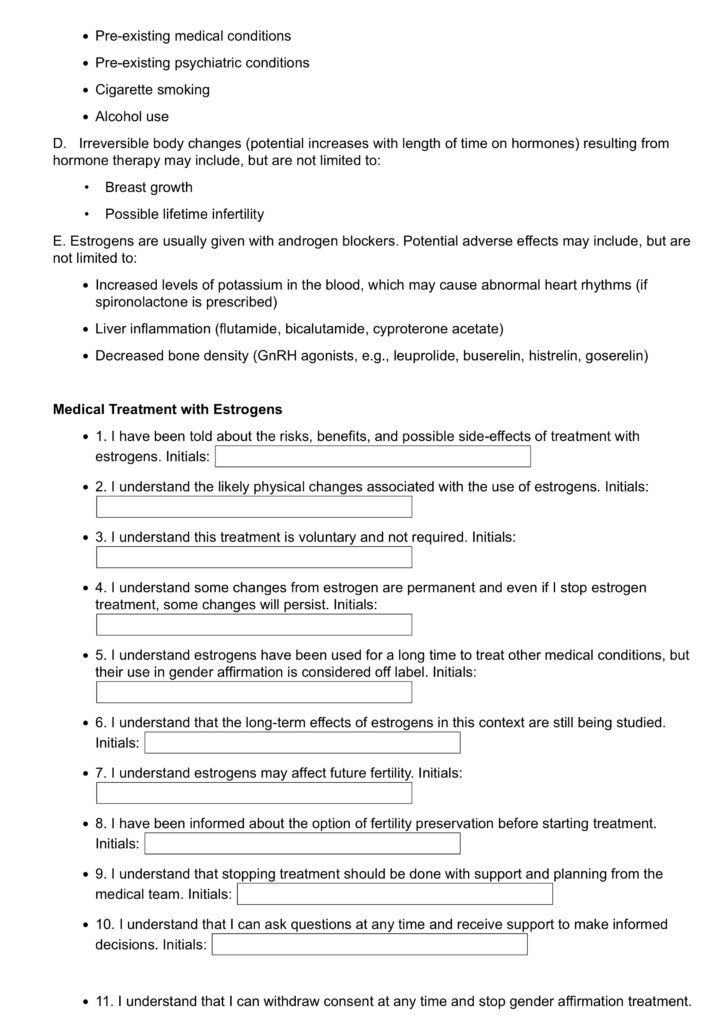
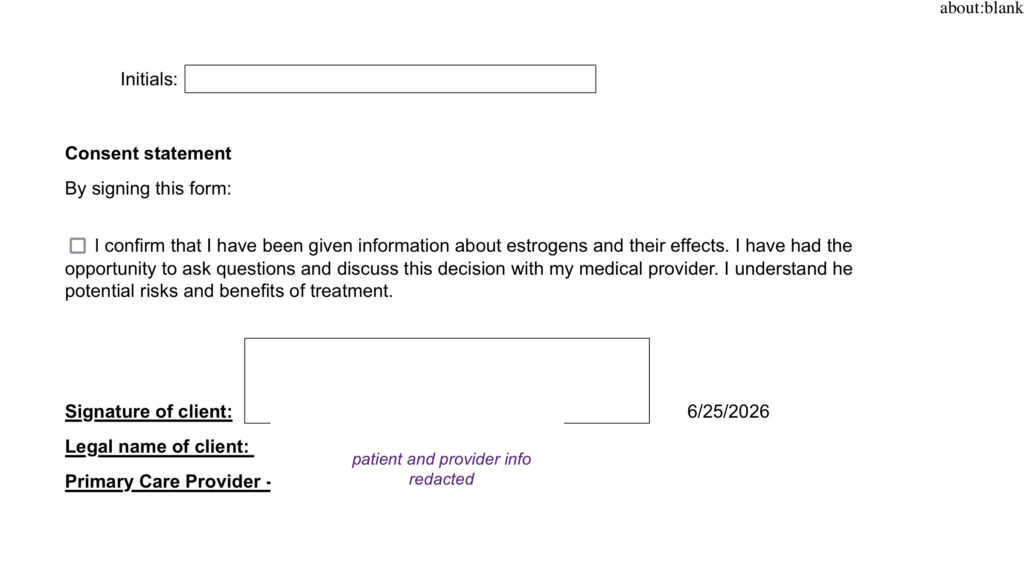
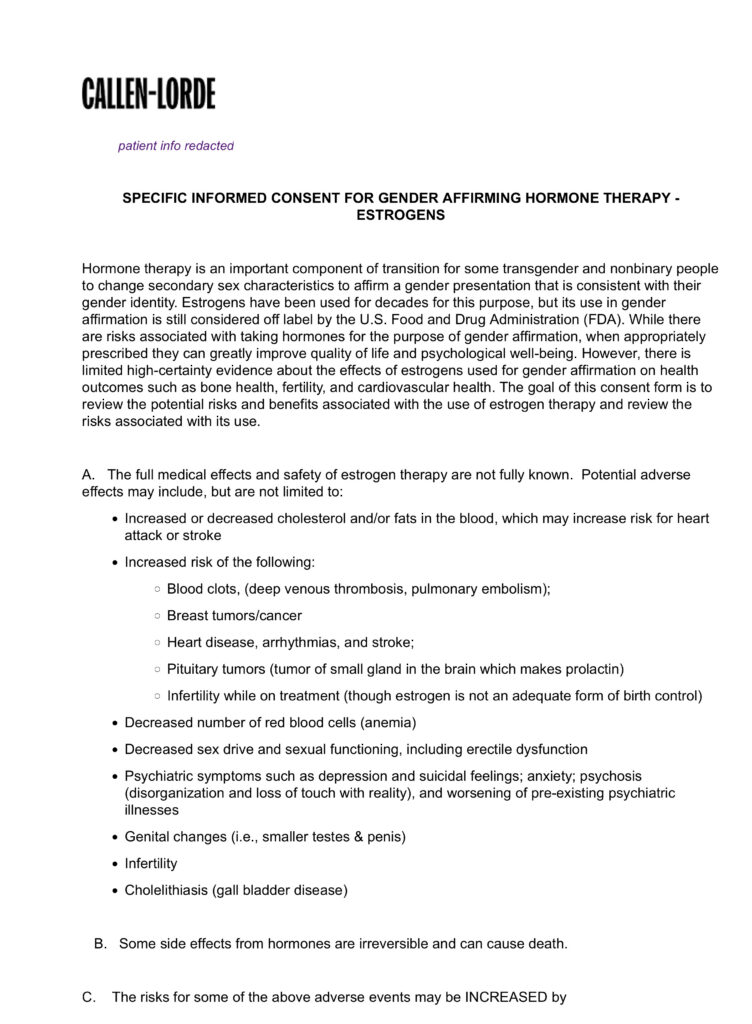
i’ve just received a notice from Callen-Lorde Community Clinic (known to new yorkers as “big gay health”) asking me to sign a “SPECIFIC INFORMED CONSENT FOR GENDER AFFIRMING HORMONE THERAPY – ESTROGENS” form (pix/alt-text below).

i will not be signing it.

this is adapted from what I wrote to the Callen-Lorde leadership, and what i posted elsewhere:

this new “informed consent” form is either (1) pre-emptive compliance with the regime’s demand for a list of trans people receiving medical care; (2) an ill-thought-out and utterly useless attempt at ass-covering against the regime by creating exactly the documentation they want; (3) a scare tactic to push trans people off HRT.

the form’s list of side effects of exogenous estrogen is based on research that was not done on trans women, and is in many cases outdated. it is framed in ways that directly use the language and scare-tactics of the anti-trans far right.

this is a conscious and disgusting betrayal of Callen-Lorde’s trans patients. that’s true whatever the motives behind it, whatever imaginary game of fuck-you-dimensional chess the clinic’s leadership and lawyers think they’re playing.

you resist genocidal policies by refusing to do anything that even vaguely complies with them, not by doing what they tell you – and especially not by doing what they tell you and pretending it’s non-compliance.

here is where you can find a list of the people in charge at Callen-Lorde (though without contact information for any of them). the only person i found on social media (a very shallow search) willing to admit to their job at CL is Executive VP for Research & Education asa radix: @asaradix.bsky.social

give them all a piece of your mind.

tell them not to collaborate with the regime & its anti-trans allies. tell them to yell at our mayor (who has so far done nothing to protect trans health, despite specific policy and funding promises) to have their backs.

and remind them we can see them.

remember:

“informed consent” gatekeeping is just regular gatekeeping whenever the doctors and other “experts” in charge decide it is – including trans “expert” gatekeepers.

you can’t identify yr way out of a structural relationship.

you can’t 501c yr way out of a structural relationship.

this underscores why we (trans ppl, but also others) need full-scale autonomous healthcare structures to have secure, sustainable access to health care. and why it’s a damn good thing the starting point for that has been HRT compounding and redistribution.

if you want estrogen, there is a project near you who can hook you up. ask a trans woman who’s a punk, or an anarchist, or both. and remember: the fearmongering about sources of HRT is the same as the fearmongering against HRT. more on all that here.

take care of your sisters & siblings.

refuse to collaborate with the regime. as keguro macharia asks: “how are you imagining freedom today? how are you practicing freedom today?”

and as margaret killjoy writes: “love comes before tear gas like ozone comes before a storm.”

the state will not protect us. even your favorite politician.

the 501Cs will not protect us.

we will protect and free ourselves.

autonomous trans healthcare now! and nothing less.

and because we cannot be free unless all of us are free:

abolition now! and nothing less.
trans health care: a taxonomy of HRT access

in the department of screaming into the wind, it seems useful (if perhaps optimistic) to try to be concrete about the different pathways that trans liberals and antitrans organizers alike try to conflate, as part of their shared commitment to Professional Expertise (a/k/a doctors; a/k/a gatekeeping). that’s especially visible right now, as they attempt to redefine “DIY” in the context of HRT, pushing to keep us all dependent on state-licensed gatekeepers for access to the drugs many of us use, need, and want.

in the u.s. there are four basic pathways for getting drugs that you can use to adjust your endocrine system. (the specific examples i use are going to be about estrogens, since the greater legal restrictions on testosterones have made the process of developing autonomous pathways slower and quieter – but the same structure applies.)

two are commercial:

(1) by prescription. you go to a state-licensed gatekeeper, persuade them that you meet one or another set of arbitrary criteria, and are then allowed to pay a pharmaceutical company (directly or through an insurance company) for one drug off a very short list of possibilities1, with a state-licensed pharmacy taking a cut off the top.

(2) from unlicensed pharmacies/dealers. you go to a website2, and pay them (often using one or another form of blockchain pseudo-currency) to send you however many drugs you want, off a longer list of possibilities. the drugs come from the same manufacturers that supply the pharmaceutical companies.

two are autonomous:

(3) from community-based compounding projects. you go to a table at an event, or some other distribution point, and are given one or more drugs from a very limited selection3 (which is often just a choice between injectable and transdermal preparations of the same drug). you may be asked to contribute a nominal amount to support the ongoing project, but are not refused drugs if you can’t pay. the drugs are compounded (put into usable form) by community members, with the raw drug coming from the plants that supply the manufacturers of the commercial versions.

(4) from community-based redistribution projects. you go to a distribution point and are given a choice of whatever drugs they have on hand, which mainly come from the limited options available by prescription. you may be asked to contribute a nominal amount to support the ongoing project, but are not refused drugs if you can’t pay. the drugs come from either the prescription pathway (#1) or the community compounding pathway (#3).

there is a third possible autonomous pathway. i’m separating it off because i don’t know whether there are any projects currently working on using it. i hope there are, and i hope that they’re being very careful who they talk with about it.

(*5) from community-based production projects. when this exists, you’ll go to a distribution point (likely one established for the community compounding (#3) pathway) and choose from a limited selection on a pay-what-you-can basis. the raw drugs will come from a community compounding project, using raw drugs synthesized by a community-based manufacturing project.


of these pathways, only #3 is “DIY” in any meaningful sense (and #5 will be once it exists). #1 and #2 are gatekept efforts – one by the doctors and pharmacists who control access to prescription drugs; one more impersonally, by the prices they charge; #4, though very useful as a way around doctors and pharmacists, is basically dependent on #1 rather than an alternative to it.

but the distinction that matters here is between commercial and autonomous pathways of access. #3 and #4 (and #5 once it exists) are pathways in which trans people are directly supplying trans people with drugs, without the gatekeeping presence of either Professional Expertise or the profit motive. within the autonomous zone, #4 is much more limited in its scope than #3, since its supply of drugs depends on donors who both can persude a doctor to give them a prescription and don’t need to actually use all of the drugs they’re prescribed. these pathways are not in competition with each other, and can be mutually supportive: one of the useful functions of #3 can be to provide drugs to people with prescriptions, so that their pharmacy-packaged supply can be redistributed through #44.

importantly, #2 is neither “DIY” nor autonomous in any meaningful sense. it’s an alternative to getting drugs by prescription, but it is neither community-controlled nor based on providing the maximum access to as many people as possible. and given that the people most likely to be uninsured (and thus without access to prescription drugs made affordable by insurance coverage) are poor people, no commercial operation does much of anything to change the patterns of who can and can’t get access.

trans liberals and anti-trans organizers both participate in the demonization of what they call “DIY hormones”. they tend to focus on #2, using the legitimate reasons to be especially cautious about that pathway5 as a starting point for attempts to discredit any pathway that doesn’t run through state-controlled gatekeeping checkpoints – that is, anything but #1. their arguments are garbage, and i won’t even get into rebutting them here.

but it’s important that we not accept their redefinition of “DIY”. if it’s not community-based and community-controlled, with no barriers to access (economic, diagnostic, age-based, or otherwise), it’s not DIY. it may be good; it may be useful; it may not involve the state directly. but it’s not DIY if we aren’t doing it ourselves.

if the past decade has taught us nothing else, it should teach us that we cannot rely on the state to provide or protect trans people’s access to health care of any kind. what the state gives – grudgingly, belatedly, and stingily – can be taken away by that same state – rapidly and enthusiastically – always, and at any time. “legality” doesn’t come into it; the state, after all, is what decides whether a law will be ignored or enforced (that “discretion” is an inextricable element of the state as a structure, at the core of every state, whether a theocracy, a people’s democracy, or a parliamentary republic).

autonomous trans health infrastructure is the only way that we can actually maintain access to the drugs and the care we need. community-based compounding and redistribution projects are laying the foundations for the decentralized network that will save our lives – if we make those foundations strong and broad, and build on them!


  1. on the estrogen side, usually the only drugs that are available by prescription are estrodiol cypionate and estradiol valerate (which can come in injectable, tablet, or transdermal forms). these have a notably steep absorbtion curve, which means that the drug’s effects vary significantly over the time between doses (for injectable versions, often a week). ↩︎
  2. or potentially, for some forms of testosterone, a dealer catering to the gym-rat/body-building crowd. ↩︎
  3. most current community compounding projects are making estradiol enanthate, which has a flatter absorbtion curve than cypionate or valerate, meaning that its effects are less variable over the time between doses). ↩︎
  4. this shift of prescribed supply can be useful in many ways: there are situations where it’s safer to carry a vial that has a manufacturer’s label on it (including at borders); some people are scared of or hesitant to use DIY-compounded drugs; some people prefer valerate or cypionate over enanthate; etc. ↩︎
  5. which have much more to do with past periods of trans health access than the present. in the past, many (if not most) unlicensed sources were charging high prices for low-quality drugs, and often drugs that had been replaced in the prescription sphere. and some were selling actively harmful drugs, or alleged drugs that didn’t actually do anything. that’s much less true today. that’s much less true now, because the push to drive pharmaceutical manufacturing into low-wage overseas factories has made it much easier to get access to the supply chain for “legitimate” drugs, at either as raw materials (#3) or fully-produced medications (#2). but the profit motive can still lead to dangerous cost-cutting measures that make the actual dosage not match the label, or use harmful materials in the compounding process. and as in past periods, that a commercial supplier is trans, or has trans people willing to vouch for them, does not make them any less motivated by profit. ↩︎